
Endometriosis and Depression: What Years of Pain Can Do To Your Mental Health.
Living with endometriosis can wear you down. The pain, the years of being told it’s normal, the cancelled plans. So it’s not surprising that research finds depressive symptoms are more common in women with endometriosis. But knowing why, and what helps, can make it feel less like something is happening to you. Here is what the research says, and what you can do with it.
Want to read about endometriosis, check out this article here.
First, let’s look at the stats:
A review study on around 100,000 women showed that women with endo have significantly higher depressive symptoms than women without endo [1]. How much higher the risk is for women depression is difficult to assess and compare because of researchers testing different samples and use different measurement tools. One study has found that depression occurs roughly 2.5 to 3.5 times more in women with endometriosis than in the general population [2]. Depression occurs in 4-6% of people in the general population, and this study found a prevalence rate of 14.5% in women with endometriosis. My own research for my thesis found an even higher rate (70% - although it could be that women with more severe symptoms were more motivated to fill in my questionnaire).
The biggest factor seems to be pain, not the endo diagnosis itself. So treating the pain could also have an impact on your mood. It doesn't mean mild pain protects you: depression can happen at any pain level. Read more about the psychological approach to pain management.
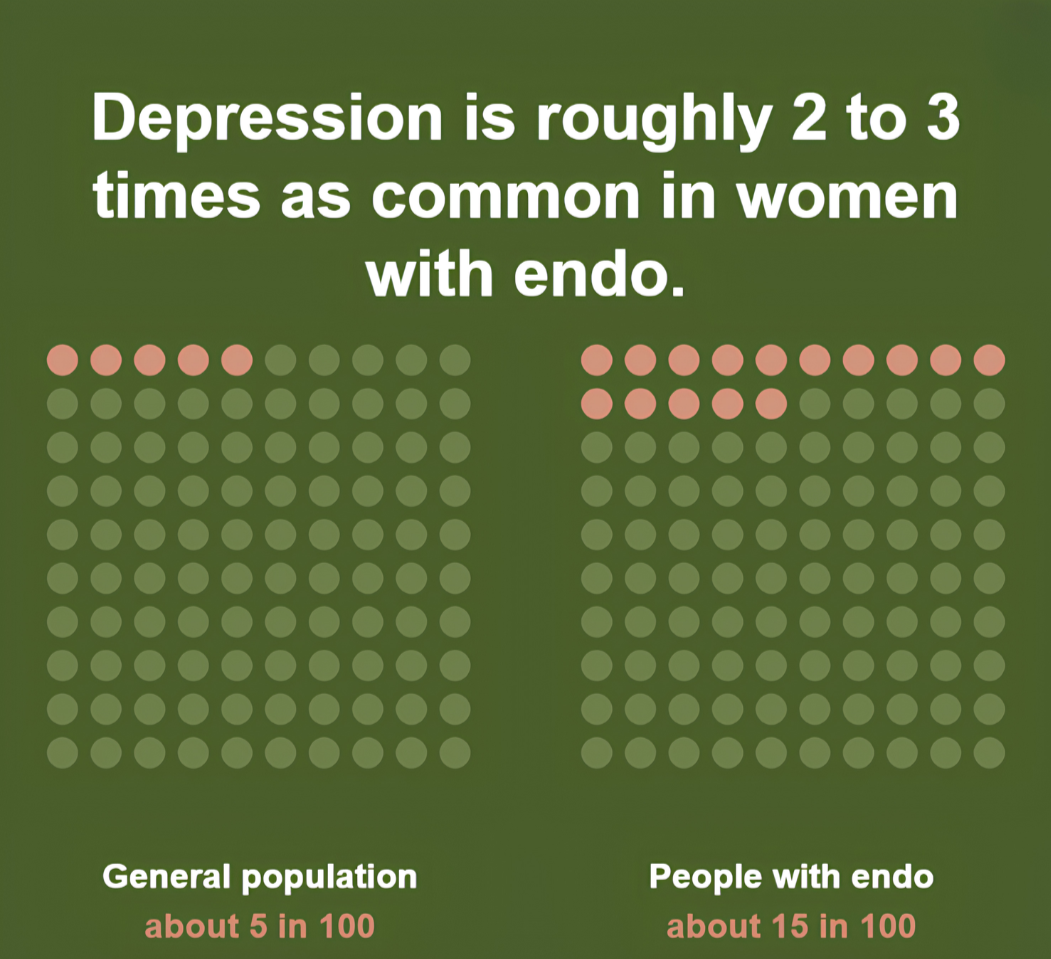
What do all these numbers mean for you?
These numbers describe group averages, not your personal odds. Your personal risk comes down to many things: your specific lifestyle, life events, support and genetics - not this statistic! What it does tell you is that as a group, women with endo carry a meaningfully higher risk than people without it.
This might feel quite confronting to read. And the intention is not that you now feel like since you have endo, you will definitely develop depression. Its a pattern across many women, not a prediction for you personally. The goal is to become aware. If you notice your mood changing, then I have listed some proactive steps you can take against it.
Why are depressive symptoms more common with endometriosis?
There are multiple ways these two can be connected.
Endo is exhausting.
Many people with endo wait years for answers while their symptoms are labelled as “normal”. They live with unexplained pain that interrupts daily life, month after month. Over time, that takes a toll on mental health.
One explanation for how this can lead to low mood is hopelessness theory of depression: When something stressful feels out of your control, and you start to expect it won’t change, hopelessness can build over time [3]. The expectation, not just the stressor itself is thought to drive low mood.
In endometriosis specifically, studies have found that depression is more common in people who feel they have little control over their illness, who tend to expect the worst from their pain, or who find themselves going over their symptoms repeatedly in their head [4]. Its an understandable response to a very hard situation, not something to feel guilty about. The good part of this finding is that thoughts and habits like these can be worked on with the right support.
2. Inflammation may play a part too.
If you are not into biology, skip to the next section. Basically: Inflammation is probably a piece in the puzzle.
Endometriosis is an inflammatory condition because the immune system is activated around the endo tissue, and chemical messengers called cytokines are released [5]. Some cytokines travel through the blood and can affect other parts of the body, including the brain (cytokines can influence neurotransmitters, neural activity and neuroplasticity) [6]. The cytokine theory of depression proposes that high inflammation can contribute to low mood [7].
Research has found that increasing cytokine activity can increase depressive symptoms in some people. And anti-cytokine treatments have found improvements in mood (mostly in people who already had high cytokines- results are mixed)[8]. Antidepressants also lower inflammation markers modestly [9].
The evidence for this theory is not rock solid, this has not been studied extensively yet, and the connections are far more complex than explained here, but inflammation (cytokines) does seem to play a role in this picture.
Worried about developing depressive symptoms? Here’s what actually helps.
Research can’t tell us exactly what needs to be done to prevent depression in women with endometriosis. We do however know of some things that are linked to better mood across many groups of people. But none of these are a guarantee. Depression can happen even when you do everything “right”, and if it does, that isn’t a failure.
Social connections: This doesn't mean forcing new friendships. It can be as small as texting a friend back today, saying yes to the thing you’d usually skip, or setting up a standing call with someone who gets you. Consistency is more important than intensity. There is a clear link between your social support and depressive symptoms [10].
Exercise: Some people with endo can’t exercise around menstruation, and that’s completely fair. On the days you can, being active is important. Even 10 minutes of walking or gentle stretching counts. Being physically active is can improve your mental health - it reduces your inflammation levels too [11].
Psychoeducation: Understanding how depression works, which is what you’re doing right now by reading this, lowers your risk on its own. Recognising your own early patterns means you can catch a slide before it deepens, instead of noticing it when you’re already in it [12].
What are the symptoms of depression?
Depression doesn't always look like sadness. For some people, it's things feeling flatter, not necessarily worse. For others the range of emotions shifts lower: the lows get lower, but the highs get harder to reach too. The good things stop feeling the way they used to. Alongside that, your inner narrator tends to get slightly more negative, quicker to criticize, and slower to give you credit.
With endometriosis specifically, this gets harder to spot, because fatigue, brain fog, appetite changes, and disrupted sleep can all be depression, the illness itself, or both. It can be confusing to know what is causing what. Specifically, symptoms that indicate depression are: losing interest in things you used to enjoy, feeling worthless or guilty, hopeless and feeling this way most of the day, nearly every day, for two weeks or more. Endometriosis symptoms fluctuate with your cycle and pain. While depression tends to be more constant (unless you are experiencing PMDD).
You might also have a higher risk of depression when taking hormonal endometriosis treatments. This is worth bringing up with your doctor if you notice a change in your mood that seems to correlate with taking new hormonal contraceptives.
I think I have depression:
Everyone sometimes feels sad or low, especially when in a difficult phase in life. However if this “lowness” isn't going away (lasting longer than around 2 weeks), and is stopping you from living your life the way you used to, you should speak to your GP or a mental health professional.
What type of therapy should you do? Both cognitive behavioral therapy (CBT) and Acceptance and Commitment Therapy (ACT) have good evidence for helping people depressive symptoms and chronic pain. You should do whatever type of therapy feels best for you. I would recommend ACT specifically, since it doesn't ask you to eliminate pain or challenge whether your thoughts about it are "true," (which matters for a condition like endometriosis where pain is often doubted). Instead it focuses on building a life you value alongside the pain. Whatever therapy you pick, an important factor for the success of the therapy is whether you have a good fit with your therapist.
If you are experiencing moderate or severe depressive symptoms, antidepressants are also an option. This is something you can discuss with your doctor. Its also important to tell your doctor about any hormonal endo treatments you are currently using
If you experience thoughts of suicide, please know that talking about it doesn't make it more likely to happen. If anything, it tends to do the opposite, by taking some of the weight off you. Please get in contact with someone, whether that's a friend, family, a doctor, or a crisis line.
Where this leaves you:
Endometriosis is hard on the body, and it makes sense that it can be hard on the mind too. Low mood is common in people with endo, and a lot of it seems to come from living with pain that is generally not taken seriously, not from anything you did or didn’t do. You can’t control whether it shows up, but you can notice it early and get support, and that is a strength, not a weakness. If your mood has been low for more than two weeks, please speak to your GP or a mental health professional. You deserve care for your mind as much as for your body!
References:
Pietro Gambadauro et al., “Depressive Symptoms among Women with Endometriosis: A Systematic Review and Meta-Analysis,” American Journal of Obstetrics and Gynecology 220, no. 3 (2019): 230–41, https://doi.org/10.1016/j.ajog.2018.11.123.
F. Friedl et al., “Impact of Endometriosis on Quality of Life, Anxiety, and Depression: An Austrian Perspective,” Archives of Gynecology and Obstetrics (Berlin/Heidelberg) 292, no. 6 (2015): 1393–99, https://doi.org/10.1007/s00404-015-3789-8.
Depressive Disorder (Depression). https://www.who.int/news-room/fact-sheets/detail/depression. Accessed 9 Oct. 2026.
Richard T. Liu et al., “The Hopelessness Theory of Depression: A Quarter-Century in Review,” Clinical Psychology: Science and Practice 22, no. 4 (2015): 345–65, https://doi.org/10.1111/cpsp.12125;
Lyn Y. Abramson et al., “Hopelessness Depression: A Theory-Based Subtype of Depression,” Psychological Review (US) 96, no. 2 (1989): 358–72, https://doi.org/10.1037/0033-295X.96.2.358.
R. A. Davenport et al., “Neuroticism and Cognitive Correlates of Depression and Anxiety in Endometriosis: A Meta-Analytic Review, Evidence Appraisal, and Future Recommendations,” Journal of Psychosomatic Research 187 (December 2024): 111906, https://doi.org/10.1016/j.jpsychores.2024.111906.
Jessica Maddern et al., “Pain in Endometriosis,” Frontiers in Cellular Neuroscience (Lausanne) 14 (2020): 590823-, https://doi.org/10.3389/fncel.2020.590823.
Neil A. Harrison et al., “Inflammation Causes Mood Changes Through Alterations in Subgenual Cingulate Activity and Mesolimbic Connectivity,” Biological Psychiatry (United States) 66, no. 5 (2009): 407–14, https://doi.org/10.1016/j.biopsych.2009.03.015;
Charles L. Raison et al., “Cytokines Sing the Blues: Inflammation and the Pathogenesis of Depression,” Trends in Immunology (England) 27, no. 1 (2006): 24–31, https://doi.org/10.1016/j.it.2005.11.006.
Jana Haase and Eric Brown, “Integrating the Monoamine, Neurotrophin and Cytokine Hypotheses of Depression — A Central Role for the Serotonin Transporter?,” Pharmacology & Therapeutics (England) 147 (2015): 1–11, https://doi.org/10.1016/j.pharmthera.2014.10.002.
N. Kappelmann et al., “Antidepressant Activity of Anti-Cytokine Treatment: A Systematic Review and Meta-Analysis of Clinical Trials of Chronic Inflammatory Conditions,” Molecular Psychiatry (London) 23, no. 2 (2018): 335–43, https://doi.org/10.1038/mp.2016.167; G.
M. Khandaker et al., “Immunopsychiatry: Important Facts,” Psychological Medicine (Cambridge, UK) 47, no. 13 (2017): 2229–37, https://doi.org/10.1017/S0033291717000745.
Piotr Gałecki et al., “The Anti-Inflammatory Mechanism of Antidepressants – SSRIs, SNRIs,” Progress in Neuro-Psychopharmacology and Biological Psychiatry (England) 80, no. Pt C (2018): 291–94, https://doi.org/10.1016/j.pnpbp.2017.03.016.
Priya J. Wickramaratne et al., “Social Connectedness as a Determinant of Mental Health: A Scoping Review,” PLoS ONE 17, no. 10 (2022): e0275004, https://doi.org/10.1371/journal.pone.0275004.wic
Peidong Wu et al., “Effects of Exercise on Depression and Anxiety in Patients with Chronic Pain: A Systematic Review and Meta-Analysis of Randomized Controlled Trials,” Journal of Affective Disorders 389 (November 2025): 119630, https://doi.org/10.1016/j.jad.2025.119630;
William J. Hanney et al., “Exercise as Medicine: Tackling Chronic Pain and Depression to Boost Quality of Life—A Narrative Review,” Sci 7, no. 1 (2025): 10, https://doi.org/10.3390/sci7010010.www
Adriana Munhoz Carneiro et al., “Psychoeducation as an Adjunctive Treatment for Depression: A Systematic Review and Meta-Analysis,” Journal of Affective Disorders Reports 21 (July 2025): 100950, https://doi.org/10.1016/j.jadr.2025.100950;
Rocío Casañas et al., “Effectiveness of a Psycho-Educational Group Program for Major Depression in Primary Care: A Randomized Controlled Trial,” BMC Psychiatry 12 (December 2012): 230, https://doi.org/10.1186/1471-244X-12-230.
© 2026 Natascha Storf, Clinical Curiosity. This article may not be reproduced or republished without written permission.
